

The Average Consumer Is Disappearing. What’s Next?
Consumers now trade down in some categories and up in others, forcing brands to rethink value, competition, and growth
August 31, 2026
Author: Matt Lathbury
Reading time: 18 min
SHARE




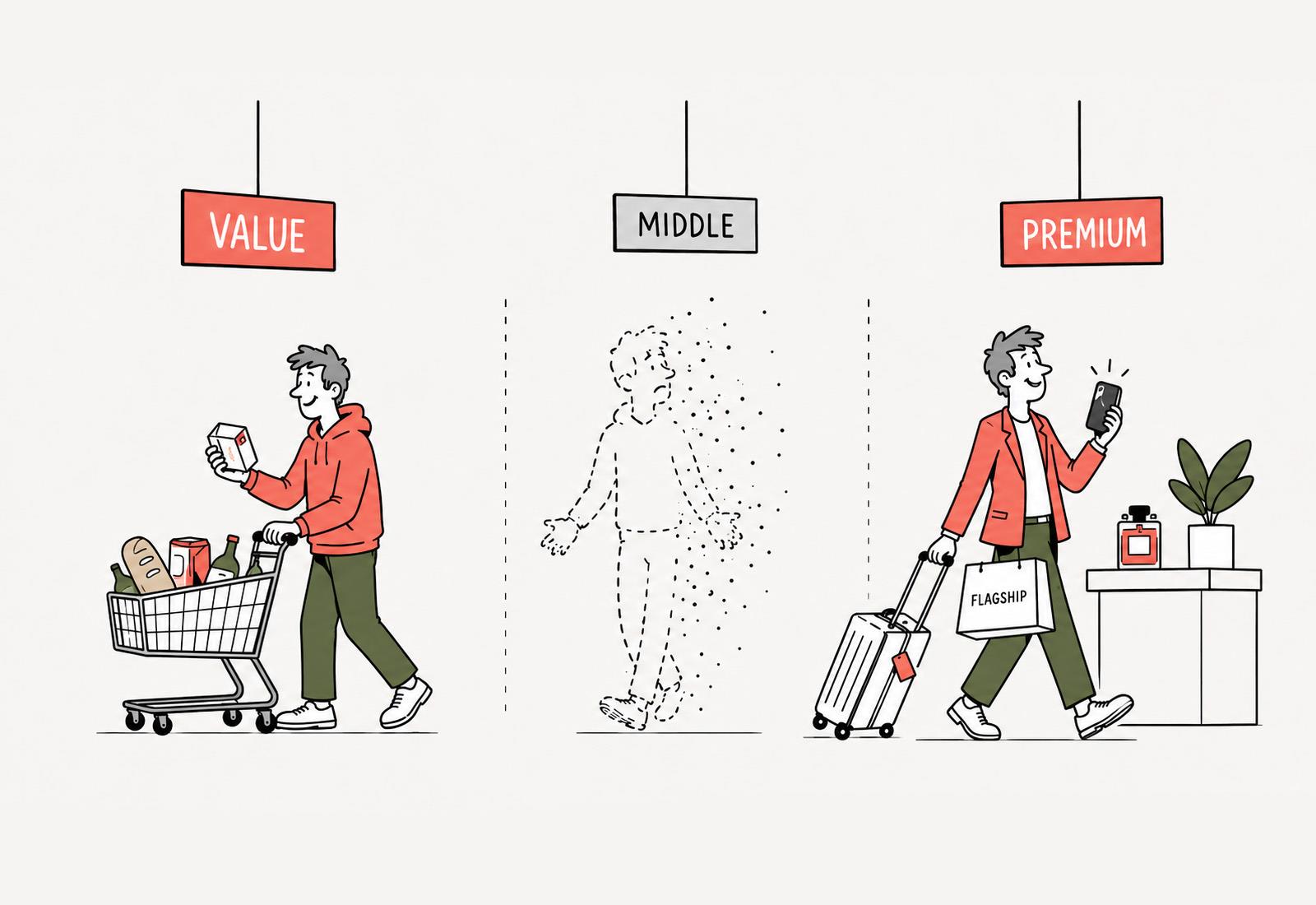
• The average consumer is disappearing because people no longer buy consistently cheap, mid-priced, or premium products, but switch spending levels across different categories
• The same person can buy affordable groceries at Lidl, own an iPhone, and purchase Chanel because each category serves a different personal priority
• A company now competes not only with similar products, but with every alternative purchase that could claim the customer’s limited money and attention
• Food spending increasingly buys experience rather than basic nourishment, making restaurants and premium foods compete with smartphones, sneakers, entertainment, and travel for consumer attention
• To win, brands must understand what customers are willing to postpone, downgrade, repair, buy secondhand, or abandon to afford and prioritize their offering
• Premium pricing succeeds only when customers can clearly see and trust the superior performance, quality, design, service, convenience, or emotional return being offered
The consumer who trades down on groceries may trade up on technology, health, fragrance or travel. The new growth question is not simply who can spend more, but where the same wallet refuses to compromise.
The average consumer is not disappearing from statistics. It is disappearing as a reliable explanation of individual buying behavior. Age, income, household type and geography still matter, but they increasingly fail to explain why the same person behaves like a value shopper in one category and a premium buyer in another.
NielsenIQ and World Data Lab put this unusually clearly in A Tale of Two Consumers: The Polarized Mindsets Reshaping Global Consumption, published August 12, 2026. Their research finds consumers across income levels, generations and markets moving between two mindsets: paying more where value is convincing and trading down where it is not.
That is a more important development than simple premiumization or simple trading down. A single household can do both, according to the same August 12, 2026 NIQ and World Data Lab report. The old assumption that every consumer belongs permanently to value, mainstream or premium is becoming increasingly difficult to defend.
The implications are profound. The strategic question for B2C companies is shifting from "Who is our target consumer?" toward something more precise: Where does this consumer want to save, where are they willing to spend, and what must our brand deliver to earn the difference?
Twenty Years Ago, Averages Worked Better
The consumer of 2006 was not psychologically simpler than the consumer of 2026. What was simpler was the market surrounding that person. Distribution, mass media and physical retail constrained the number of choices that most consumers could conveniently discover, compare and purchase.
A useful longitudinal illustration comes from the U.S. Census Bureau's Quarterly Retail E-Commerce Sales, released May 18, 2026. Its revised historical series shows e-commerce representing only 2.7% of seasonally adjusted U.S. retail sales in the first quarter of 2006.
That figure should not be mistaken for a global measure of consumer sophistication. It shows something narrower but important: twenty years ago, the digital channel through which consumers could escape local assortment and compare alternatives represented a much smaller share of actual retail purchasing.
A consumer could certainly buy premium in one category and cheap in another. But finding substitutes, comparing hundreds of prices, reading thousands of reviews and identifying obscure global competitors demanded considerably more effort. Brand fame and shelf presence therefore enjoyed more protection from immediate comparison.
The result was a market in which demographic and socioeconomic averages were more operationally useful. A middle-income household was not guaranteed to buy mid-market products, but the commercial environment gave marketers fewer reasons to expect the household to jump constantly between radically different value propositions.
Fifteen Years Ago, Comparison Became a Consumer Habit
By the first quarter of 2011, e-commerce had reached 4.7% of adjusted U.S. retail sales, according to the same U.S. Census Bureau historical series published with its May 18, 2026 Quarterly Retail E-Commerce Sales. That was still modest, but almost twice the 2006 share.
More important than the transaction share was the new consumer infrastructure surrounding it. Search, smartphones, social networks, online retailers, comparison engines and reviews were lowering the cost of questioning established brands. Price and quality became easier to separate from reputation.
A consumer could discover that an inexpensive hotel had better reviews than a famous one, that an unfamiliar product offered superior specifications or that a premium brand was cheaper somewhere else. The consideration set was escaping the physical shelf.
Something else was happening at the same time. Brand awareness was becoming less dependent on purchasing power. Consumers could follow, discuss and desire products that remained financially inaccessible. Aspiration began globalizing faster than incomes.
Ten Years Ago, Geography Lost More of Its Power
By the first quarter of 2016, e-commerce represented 7.7% of adjusted U.S. retail sales, according to the U.S. Census Bureau time series accompanying the May 18, 2026 Quarterly Retail E-Commerce Sales. The share had nearly tripled compared with 2006.
By then, the smartphone had placed the marketplace in the shopper's hand. Consumers could investigate an unfamiliar brand inside a store, compare another retailer's price, check product performance, watch demonstrations, find discount codes and order a substitute before leaving the aisle.
This weakened one of the traditional advantages of the mainstream brand. Familiarity still mattered, but it increasingly had to compete against evidence. Distribution still mattered, but it was becoming harder to convert distribution alone into unquestioned pricing power.
The consumer was also becoming more capable of active cross-category budgeting. A low-cost flight could release money for a better hotel. Cheaper household basics could fund premium sneakers. Savings on insurance could reappear in restaurants, entertainment or technology.
Five Years Ago, Habits Became Replaceable
By the first quarter of 2021, e-commerce represented 14.9% of adjusted U.S. retail sales, according to the revised historical series in the U.S. Census Bureau's May 18, 2026 Quarterly Retail E-Commerce Sales. That was almost double its 2016 share.
The pandemic accelerated something more important than online shopping. It forced households to reconsider routines almost simultaneously. People changed retailers, brands, restaurants, workplaces, entertainment habits and travel behavior with a speed that would previously have seemed improbable.
Consumers learned that many habits were replaceable. The same supermarket was not essential. A familiar brand could be substituted. Some paid services could be done at home. At the same time, certain seemingly discretionary purchases became psychologically protected because they delivered comfort, connection, convenience or pleasure.
That period taught households an enduring form of consumer capital allocation: compromise where the loss feels small, protect where the value feels personal.
Then Inflation Turned Flexibility Into Discipline
NielsenIQ and World Data Lab reported on August 12, 2026 in A Tale of Two Consumers that global FMCG prices rose 26% between 2021 and 2025. Their conclusion is important: the result was not simply a more cautious shopper, but a more discerning one.
McKinsey & Company's State of the Consumer 2026: When Tech Acceleration and Cost Pressures Collide, published June 22, 2026, reaches a similar conclusion. More than three-quarters of consumers continue some form of trading down, but their behavior differs substantially between essential and discretionary categories.
For essentials, McKinsey observes consumers switching brands, changing pack sizes or seeking promotions. In discretionary categories, consumers increasingly change whether and how they buy at all. Trading down is therefore not one behavior. It is a portfolio of different responses to perceived value.
Even consumers with substantial purchasing power are participating. McKinsey's June 22, 2026 report finds higher-income consumers adopting budgeting tools, do-it-yourself behavior and other optimization practices by choice, while reserving spending for moments they consider sufficiently worthwhile.
This is the central point.
The average consumer did not simply become poorer. The consumer stopped behaving like an average within a single wallet.
The Lidl Shopper With the Premium iPhone
Consider a realistic composite German consumer. Much of the weekly grocery basket comes from discounters such as Lidl and Aldi. Promotions matter. Retailer brands are accepted without embarrassment. Paying substantially more for a national brand of an everyday product may feel economically irrational.
Boston Consulting Group's 2026 Consumer Sentiment Survey: Germany, published June 9, 2026, found that 55% of Germans frequently or almost exclusively purchase retailer-owned grocery brands, compared with 39% across BCG's European sample. Depending on the category, discounts influence up to 74% of German purchase decisions.
Circana's Private Label Reaches Record 50% Unit Share Across Europe's Six Biggest Grocery Markets, published April 20, 2026, provides transaction evidence. Private label accounted for 52% of FMCG units in Germany, while branded products were placed on promotion far more frequently than private label.
Now imagine the same consumer purchasing the newest iPhone on a 24-month installment plan. The exact Lidl-plus-iPhone individual is an illustrative composite, not a person tracked by a published study. What matters is that the two behaviors are entirely compatible with today's market evidence.
Counterpoint Research reported in Premium Smartphone Share in Overall Market Hits H1 Record at 29%; Apple and Samsung Lead, published August 4, 2026, that premium smartphones reached a record 29% of global smartphone sales during the first half of 2026.
Counterpoint had already shown why on March 31, 2026 in Accessible Flagship Smartphones Might be the Best Value for Consumers in 2026. Its $700 to $999 wholesale segment grew 25% during 2025 and became the fastest-growing global smartphone price tier, reflecting demand for premium performance with a defensible value equation.
The same report explains that trade-in mechanisms and pricing architecture increasingly help consumers access premium features without accepting the highest possible upfront price. The premium technology customer is not necessarily unconcerned about money. Often, that customer is intensely concerned about whether the money produces enough additional utility.
That is why discount groceries and premium technology can coexist rationally. Flour, detergent or milk may appear highly substitutable. A smartphone used for communication, photography, payments, navigation, entertainment and work may occupy an entirely different place in the consumer's hierarchy of value.
And Then the Same Consumer Can Buy Chanel
The same logic can extend into luxury fragrance. The exact person buying Lidl groceries, an iPhone and Chanel fragrance has not been identified by any dataset used here. It should therefore remain an illustrative consumer profile rather than be presented as measured cross-category behavior.
The market conditions supporting that profile are real. Chanel Limited reported on May 19, 2026 in Financial Results for the Year Ended 31 December 2025 that revenue reached $19.3 billion, with fragrance and skincare specifically identified as drivers within its Fragrance and Beauty activity.
A fragrance occupies another psychological account. It can represent identity, ritual, status, memory, intimacy or self-reward. The rational question for the buyer is not whether Chanel and Lidl belong in the same price segment. They obviously do not.
The relevant questions are category-specific. Where is paying more pointless? Where does paying more produce something I notice? Where does the purchase make me feel differently?
Once those questions replace a single "premium consumer" label, the apparent contradiction largely disappears.
The Organic Shopper Seeking Value in Travel
A second composite reverses the pattern. This consumer scrutinizes ingredients, favors organic food and refuses to economize on perceived health quality. Yet the same household may spend hours seeking the least expensive acceptable package holiday or all-inclusive offer.
Germany again provides useful evidence. The Bund Ökologische Lebensmittelwirtschaft reported on May 3, 2026 in BÖLW: Bio-Umsätze boomen trotz Inflation that organic food and beverage sales grew 6% year on year in the first quarter, reaching €4.91 billion.
The apparently premium "Bio shopper" is also increasingly a discount shopper. The same May 3, 2026 BÖLW release found discounters accounting for 30% of German organic sales, the largest channel share in that quarter, while retailers' organic private labels grew 12.5%.
By August, the pattern remained resilient. BÖLW reported in Bio wächst trotz Konsumflaute, published August 3, 2026, that first-half 2026 organic sales increased 4.9%, while discounters still represented 26.9% of organic sales.
The important conclusion is not that every organic shopper is financially constrained. It is that organic and discount retail are no longer opposite consumer identities. Health preference and value optimization can exist inside the same basket.
Travel can follow a similar pattern. McKinsey's June 22, 2026 State of the Consumer 2026 reported travel experiences growing 4.4% between 2023 and 2025, while consumers across generations continued to rank cost as the most important consideration when purchasing experiences.
The same research asked what consumers would do with an extra $200 intended as a treat. Across every age group, the most common answer was to save it for a vacation. Consumers therefore appear willing to protect travel while remaining intensely sensitive to how efficiently they purchase it.
TUI provided a concrete value-led example on May 21, 2026 in TUI Launches New £800 Gambia Holidays from Birmingham. Packages starting at £800 per person included flights, accommodation, transfers, luggage and all-inclusive food and drink.
TUI's July 15, 2026 analysis Brits Are Overlooking an £800 All-Inclusive Perk, and It's Not the Buffet similarly emphasized activities bundled into the upfront price as a source of value. All-inclusive does not automatically mean cheapest, but it can provide unusually strong control over total holiday cost.
The organic-food buyer and value-focused package traveler therefore need not be inconsistent. Health may be a category in which compromise is rejected. Travel may be protected too, but purchased through aggressive total-cost optimization.
Consumers Are Building Personal Portfolios of Sacrifice
Other combinations increasingly make sense through the same lens. A household can buy secondhand fashion and premium skincare. It can keep an old car and protect an expensive holiday. It can economize on human food brands while refusing to compromise on the family pet.
BCG's European Consumers Are Still Cutting Back, published June 9, 2026, found 47% of surveyed Europeans buying secondhand products, while six in ten said they were willing to spend more on high-quality pet food. These are population-level findings, not proof that the same respondents always do both.
McKinsey's June 22, 2026 State of the Consumer 2026 found 82% of consumers keeping products longer before replacement, 69% repairing rather than discarding and 30% purchasing apparel secondhand. More than 20% reported secondhand purchasing in other categories.
Secondhand itself can become a gateway to premium. McKinsey's June 22 report uses the example of a $150 preowned handbag creating access to a brand whose comparable full-price product costs $600. Saving money can therefore increase participation in premium rather than eliminate it.
The old consumer model asks whether somebody is a value customer or a premium customer.
The better answer in 2026 is increasingly: it depends what they are buying, why they are buying it, and what they are willing to sacrifice elsewhere.
The United States: Pressure Does Not Produce Uniform Retreat
McKinsey's An Update on US Consumer Sentiment: Gloomier Outlook Ahead of Sunnier Days, published May 28, 2026, found American consumers increasingly concerned about costs and planning pullbacks across many discretionary categories. Importantly, even higher-income consumers reported considering cuts to "nice to have" expenditure.
This matters because value consciousness is no longer safely contained within lower-income segments. The affluent shopper may have the financial capacity to pay a premium and still reject it because the incremental benefit appears too weak.
Circana's U.S. Retail Spending Rises in Early Spring, but Underlying Consumer Pressures Signal Caution Ahead, published April 22, 2026, found U.S. retail spending growing 3.3% year on year in March while unit demand increased only 1% across the measured categories.
That environment rewards brands that distinguish value growth from real consumer enthusiasm. Revenue can rise because prices rise. The more important question is whether consumers are purchasing more, remaining loyal, moving to smaller formats, waiting for promotions or silently reallocating their budgets elsewhere.
Germany and the EU: Value Requires Proof
Across Europe, BCG's June 9, 2026 European Consumers Are Still Cutting Back found 53% of respondents worried about daily personal finances, 63% buying only at discounts or actively seeking deals, and 62% willing to switch brands for a better offer.
Yet Western European premium spending remains substantial. NielsenIQ reported on June 1, 2026 in Premium Has a New Price in Western Europe FMCG: Proof, Not Positioning that Premium+ products represented 28.2% of FMCG value and grew 4.1% year on year.
The same NIQ analysis found 60% of consumers willing to pay more for high-quality products, while 59% considered premium worthwhile when it delivered better outcomes than standard alternatives. Thirty-eight percent continued purchasing premium under budget pressure when the value remained convincing.
This is the modern European consumer in one sentence: more reluctant to waste money, but not necessarily more reluctant to spend it.
The European Central Bank added striking evidence on July 13, 2026 in What Drives Euro Area Consumers to Chinese E-Commerce Platforms. More than half of respondents had used Chinese platforms, attracted primarily by low prices and broad assortment, with usage extending into many higher-income households.
Almost two-thirds of purchases on those platforms were worth no more than €25 and 90% no more than €50, according to the ECB's July 13, 2026 analysis. Value-seeking is therefore not merely an emergency behavior among households with no alternative.
Central and Eastern Europe: Poland Shows Both Sides
Poland provides another useful example. BCG's 2026 EU Consumer Sentiment: Poland, published in June 2026 and based on its April survey, found strong discount-seeking behavior across Polish categories and substantial willingness to change brands when better offers appeared.
At the same time, KPMG Poland reported on May 7, 2026 in I kwartał 2026 na rynku motoryzacyjnym that 38,000 premium vehicles were registered during the first quarter of 2026, a 2.9% increase from the corresponding period in 2025.
These figures do not prove that the same Polish household chases supermarket discounts and buys a premium car. They demonstrate something more defensible: a consumer economy can intensify discount behavior and expand premium demand at the same time.
Africa: A Constrained Wallet Can Contain Global Aspiration
Africa is perhaps the last place where marketers should speak casually about an "average consumer." Purchasing power, currencies, retail infrastructure, urbanization and lifestyles differ enormously, while social platforms increasingly expose consumers to global beauty, technology, fashion and entertainment narratives.
NielsenIQ's August 14, 2026 analysis One Region, Different Beauty Consumers: Who's Driving Growth Across Africa and the Middle East? reported 16% value growth across its combined Africa and Middle East beauty region, compared with 10% globally. It simultaneously warned against treating that region as one consumer story.
NIQ describes South African beauty consumers as balancing efficacy with affordability, using promotions, trial sizes and multifunctional products while becoming increasingly sophisticated about ingredients. Global beauty trends influence demand, but consumers actively adapt those trends to local budgets and identity.
The broader lesson extends beyond beauty. Lower purchasing power does not imply lower brand knowledge. Consumers can recognize, evaluate and aspire to international premium products long before their frequency of purchase resembles that of wealthier markets.
Asia: Value Is Becoming More Intentional
NielsenIQ's Asia Pacific Consumers Redefine Value Amid Ongoing Uncertainty, published April 24, 2026, found consumers across the region actively managing spending through better-value choices, reductions in non-essential purchases and movement between brands and channels.
NIQ's recommendation in that April 24, 2026 report is revealing: brands should compete with precision rather than volume, optimize pack architecture, protect availability and communicate value more clearly. Reliability, transparency and relevance increasingly sit alongside price in the consumer's definition of value.
Premium technology again demonstrates why this does not mean universal trading down. Counterpoint Research's March 31, 2026 Accessible Flagship Smartphones Might be the Best Value for Consumers in 2026 found the accessible flagship tier growing 14% in Southeast Asia during 2025.
The Asian growth opportunity is therefore not simply cheap products for value consumers or premium products for richer consumers. It is increasingly about constructing a ladder through which the same shopper can move according to category, occasion and perceived payoff.
Australia: Consume Less, Protect the Occasion
Australia reveals another version of selective consumption. NielsenIQ's Making Moderation Work in Australia's Mindful Market, published August 14, 2026, found 38% of consumers saying they drank occasionally but had become more mindful, while 22% had previously drunk regularly and now consumed less.
Cost and health were both major drivers. NIQ reported 38% citing saving money and 33% health and wellbeing as reasons for drinking less. Yet 32% were still drinking out weekly, three percentage points higher than a year earlier.
The Australian consumer may therefore reduce volume without abandoning the social occasion. This distinction matters across B2C markets: growth can come from protecting the experience, function or emotional benefit even when consumers deliberately reduce total consumption.
What ICERTIAS Is Seeing
ICERTIAS research points toward the same value discipline. In Prices Top Global List of Shopping Irritations, ICERTIAS Survey Says, published July 8, 2026, ICERTIAS reported an online survey of 8,200 respondents across 50 countries in which "prices" was the most frequently cited shopping irritation, mentioned by 16.8%.
When related responses were grouped, cost-related irritation accounted for approximately 26% of answers. Yet ICERTIAS's July 8, 2026 study also found quality, misleading offers, fees, delivery, returns and service concerns throughout the responses, suggesting that consumers experience value as a broader judgment than price alone.
ICERTIAS's The New Consumer Demand: Prove the Value, published July 1, 2026, reported monthly tracking across 18 markets and 24,000 respondents. The share associating value mainly with a good price for acceptable quality fell from 61% to 47% between the first and final tracking waves.
Over the same ICERTIAS tracking period, the share emphasizing certainty that a brand's claim was true before purchase increased from 32% to 54%. The implication is not that price matters less. Price is increasingly being judged together with proof, quality and risk.
ICERTIAS researchers also report a directional internal observation from cross-market work reviewed in August 2026: respondents in some lower-income markets now spontaneously mention a broader repertoire of expensive chocolate and other premium brands than was typically visible in comparable projects roughly a decade earlier.
That ICERTIAS observation is not a harmonized ten-year panel and should not be converted into a percentage change. Samples, markets and research instruments differ across projects. Its value is directional: premium-brand awareness appears to have globalized much faster than premium purchasing power.
The lower-income consumer's wallet may remain local.
The consumer's brand universe increasingly does not.
The Real Competitor May Be Outside Your Category
This leads to a strategic issue that many B2C companies still underestimate. A brand is not competing only against products that appear beside it on a category market-share chart. Increasingly, it is competing against every alternative use of the consumer's finite money.
A premium chocolate company may believe it competes primarily with other chocolate brands. The consumer may be deciding between that chocolate, a specialty coffee, a beauty product or a streaming subscription. A €1,400 smartphone can compete with a weekend trip, restaurants, fashion or a television.
The classic marketing question is: Why did the consumer choose us instead of our direct competitor?
The deeper 2026 question is: What did the consumer choose not to buy, postpone, downgrade, repair or buy secondhand in order to make room for us?
McKinsey's June 22, 2026 State of the Consumer 2026 provides evidence of precisely the behaviors through which households free resources. Eighty-two percent are keeping products longer, 69% are repairing them, and substantial shares are buying secondhand or replacing paid services with DIY alternatives.
The same report simultaneously finds experiences remaining strongly protected, with travel experiences growing 4.4% between 2023 and 2025 and vacations becoming the most common destination for a hypothetical extra $200 treat across generations.
The strategic inference is powerful. The household repairing an appliance may be financing a holiday. The person buying secondhand clothing may be preserving money for skincare. The customer choosing private-label groceries may be protecting technology spending.
For the brand receiving that spending, the sacrificed category may reveal more about its true pricing power than the closest product competitor does.
Willingness to Pay Is Only Half the Question
Traditional pricing research asks: "How much are you willing to pay for this product?" That remains important. But it misses a second dimension of value: what is the consumer willing to give up in order to pay it?
Two customers can each spend €1,000 on the same product and have entirely different relationships with that purchase. One pays comfortably from disposable income. The other reorganizes several months of household spending because the product holds exceptional functional, emotional or symbolic value.
The second customer may actually reveal greater brand strength.
A purchase that causes consumers to postpone another purchase, downgrade another category or accept inconvenience elsewhere has earned a privileged position inside their personal spending hierarchy.
B2C companies should therefore begin constructing what might be called a Consumer Sacrifice Map. It should identify which expenditures disappear first when consumers want the brand, which purchases are postponed, which categories are downgraded and where consumers refuse to make the necessary sacrifice.
This is not merely an academic extension of willingness-to-pay research. It expands the competitive set. A travel company's demand may partly depend on consumers delaying furniture. A premium beauty brand's growth may partly depend on fewer restaurant visits. A technology brand may benefit when consumers extend the life of their cars.
The next battle for B2C growth will therefore not be fought only between competing brands.
It will increasingly be fought between competing uses of the same consumer's money.
Where B2C Growth Moves Next: Smart Value
The first major opportunity is smart value. The strongest value proposition does not make the customer feel financially constrained. It makes the customer feel competent. The psychological reward becomes: "I obtained the outcome without paying for things that do not matter to me."
Private label demonstrates this perfectly. NielsenIQ reported on August 19, 2026 in 58% of Consumers Say They Don't Care Whether a Product is a National Brand or Private Label that 58% simply choose what meets their needs, regardless of whether it is national brand or private label.
The same NIQ release found 69% regarding private label as good value for money and 67% of Gen Z considering private-label products as good as national brands. Saving has lost part of its old psychological penalty.
For established brands, the answer is not permanent discounting. It is engineering value through pack architecture, product simplification, durability, refills, subscriptions where appropriate, lower-cost entry points and elimination of benefits consumers are unwilling to finance.
The Second Opportunity: Provable Premium
Premium remains commercially powerful, but it increasingly needs evidence. NielsenIQ's June 1, 2026 Premium Has a New Price in Western Europe FMCG: Proof, Not Positioning found 56% of consumers saying premium products must justify their prices through clear features or performance.
The premium can be justified through better ingredients, measurable performance, durability, design, craftsmanship, convenience, service, provenance, health outcomes or emotional meaning. The specific benefit changes by category. The rule does not.
Consumers have not stopped paying high prices.
They are becoming less willing to pay high prices for differences they cannot see, understand or trust.
This makes self-proclaimed superiority less powerful. The premium must increasingly be legible before purchase and confirmed afterward. Product performance, credible reviews, technical evidence, warranties, independent recognition and consistent customer experience all help transform a price premium into an evidence-backed value proposition.
The Third Opportunity: Accessible Premium
A third growth zone sits between mass and the highest premium tier. Counterpoint's March 31, 2026 analysis of accessible flagship smartphones is instructive because it shows consumers seeking near-premium functionality while retaining disciplined value expectations.
Accessible premium can include smaller formats, entry products, trade-in, buyback, resale, financing and carefully structured price ladders. The objective is not to make the premium brand cheap. It is to reduce the barrier to entering the brand without destroying the reason it is desirable.
McKinsey's June 22, 2026 secondhand handbag example captures the mechanism neatly. A consumer who cannot justify $600 new may enter the same brand at $150 secondhand. That consumer has traded down on transaction structure while simultaneously trading up on brand participation.
The Fourth Opportunity: Protected Categories
The strongest categories may increasingly be those consumers are prepared to defend by sacrificing elsewhere. BCG's June 9, 2026 European research found broad cutbacks while health, wellness and pet care remained comparatively protected, with two-thirds regarding health and wellness as extremely important.
CMOs should therefore identify not merely where consumers spend most, but where they cut last. A category that survives financial pressure has stronger potential pricing power than a category whose demand depends on consumers feeling temporarily flush.
The managerial question becomes: Are we one of the expenses consumers protect, or one of the expenses they use to finance something else?
The Fifth Opportunity: Emotional Return
McKinsey's June 22, 2026 State of the Consumer 2026 found the global experiences market growing 2.6% between 2023 and 2025, compared with only 0.8% for nonessential goods. Consumers continued seeking connection, relaxation, excitement and memorable time even under financial pressure.
Physical products can participate in the same economics. Coffee can become ritual. Chocolate can become reward. Fragrance can become identity. Sportswear can become achievement. Technology can become capability. Pet care can become an expression of love.
The question is not merely whether the product performs.
It is whether the product creates enough functional or emotional return to justify what the consumer must sacrifice to obtain it.
AI Will Make Average Propositions Even More Vulnerable
Artificial intelligence further reduces the cost of comparison. McKinsey's State of the Consumer 2026, published June 22, 2026, found 28% of Gen Z already using generative AI for shopping and 60% regularly using AI-generated overviews in traditional search.
DHL's E-Commerce Trends Report 2026: Old Rules Don't Apply in the Age of AI, published June 2, 2026 and based on 29,000 shoppers and 5,800 businesses across 29 countries, found 29% of shoppers willing to let AI make purchasing decisions within five years.
AI can compare prices, summarize reviews, evaluate ingredients, identify alternatives and expose weak differentiation in seconds. Twenty years ago, mediocre products benefited from the consumer's limited time and information.
AI reduces both protections.
The Brand Website Is No Longer the Whole Brand
McKinsey's June 22, 2026 State of the Consumer 2026, drawing on XEO360 data collected from October 2025 through May 2026, found only 1% of sources cited by large language models in consumer-brand queries coming from brand-owned websites.
That means retailer pages, reviews, forums, specialist media, video, public documentation and independent third-party signals increasingly help determine how a brand appears inside AI-mediated purchasing journeys.
For B2C companies, proof is therefore becoming both a consumer requirement and a distribution problem. The brand must not only possess a credible reason to be chosen. That reason needs to exist across the information ecosystem through which humans and machines now evaluate it.
Stop Segmenting Only People. Start Segmenting Decisions.
A 38-year-old urban professional with above-average income remains a useful demographic profile. It may tell a brand remarkably little about whether she will spend heavily on groceries, skincare, technology, airlines or restaurants next Saturday.
On Monday she can be a ruthless grocery optimizer. On Wednesday she can become a premium health buyer. On Friday she can be an indulgent restaurant customer. On Saturday she can spend an hour comparing airfares to save €70.
The more useful segmentation increasingly includes purchase states: minimize cost, reduce risk, save time, protect health, care for someone, reward oneself, express identity, create a memory or acquire something expected to last.
NielsenIQ made the geographic version of the same argument on August 17, 2026 in The End of Average Markets: Why Growth Leaders Are Moving to Store-Level Precision. NIQ argues that consumers do not shop according to market averages, with needs, budgets and preferences varying significantly between neighborhoods, retailers and stores.
The principle should be taken further.
Consumers increasingly do not even shop according to their own personal average.
The Middle Is Not Dead. The Meaningless Middle Is in Trouble.
It would be tempting to conclude that every category is splitting permanently between extreme value and extreme premium. The evidence does not support such a universal claim. Mainstream propositions continue to work where they deliver trust, convenience, familiarity, health benefits or clearly understood performance.
The real danger is the product that costs substantially more than the value alternative while offering no difference the consumer can readily identify. It is the hotel that is neither inexpensive nor memorable, the appliance with no visible superiority, or the food brand whose premium exists mainly in its advertising.
NIQ's June 1, 2026 Western European premium analysis captures the new rule: premium is becoming fluid and must be earned at the moment of choice. One in three consumers was actively trading up within categories, but only where the value equation worked.
For the undifferentiated middle, that moment is becoming increasingly unforgiving.
The New Growth Equation
The average consumer is not disappearing because everyone is moving toward luxury. Nor is the consumer disappearing because everyone is trading down. The average is becoming less useful because the same person increasingly does both.
The Lidl shopper can be the premium smartphone buyer. The organic-food customer can be the aggressive travel optimizer. The high-income European can shop on a Chinese low-cost platform. The secondhand fashion customer can participate in premium beauty or technology.
The African consumer can have global premium awareness and local purchasing constraints. The Asian consumer can demand absolute value in staples and premium performance in technology. The Australian consumer can reduce alcohol volume while preserving the social occasion.
These people are not necessarily inconsistent.
They are allocating finite resources according to personal hierarchies of utility, health, identity, responsibility, pleasure and meaning.
For B2C brands, this creates a deeper definition of competition. Success will increasingly depend not only on understanding why a consumer prefers your product to another product in your category, but on understanding what else that consumer is prepared to sacrifice in order to choose you.
That may ultimately be the most revealing indicator of brand strength.
The next era of B2C growth will belong to companies that can answer three questions with unusual precision: where does the consumer want to economize, where does the consumer refuse to compromise, and what must our product prove before the consumer accepts the sacrifice required to buy it?
The old question was:
Who is our average consumer?
The better question for 2026 is:
What does this consumer consider worth paying for, and what are they willing to give up to have it?
That is where the next B2C growth will come from.
As consumers trade down in some categories and up in others, growth depends on understanding what they value and what they are willing to sacrifice