

From Being Known to Being Recommended by AI
As AI moves from recognising brands to guiding purchases, marketing must make brand strengths accessible, accurate and verifiable
November 30, 2026
Author: Matt Lathbury
Reading time: 18 min
SHARE




• AI increasingly mediates purchasing decisions, making accurate brand representation a strategic priority for marketing
• 2022–2023: Large language models (LLMs) drew on learned associations, reproducing brand narratives while risking outdated or inaccurate descriptions
• 2024–2025: Search engine optimisation (SEO) supported discovery; generative engine optimisation (GEO) addressed how AI systems represented brands
• May 2026: Technical SEO improved access to brand information, but effective GEO required credible evidence beyond well-structured content
• November 2026: AI shopping connected brand recommendations with transactions, increasing the commercial consequences of inaccurate comparisons and claims
• Today’s challenge: Brand visibility, AI recognition and recommendation credibility remain distinct outcomes, requiring marketing to measure each separately
• 2027 forecast: Personalised AI shopping could make GEO increasingly contextual, requiring brand evidence aligned with individual purchasing priorities
• 2027 risk: Faster AI purchasing could amplify flawed brand recommendations, making ongoing monitoring a core marketing responsibility
A brand can spend years establishing what its name means and discover, in a single AI answer, that it has been described quite differently. That possibility became a practical business concern when ChatGPT brought large language models to a broad public audience in late 2022, opening another channel through which consumers could encounter brands.
For a marketer experimenting with these systems in 2023, asking what an assistant “thought” about a brand was an obvious diagnostic exercise. The answer could expose outdated associations, missing information or invented attributes. Without live retrieval, the model generated its response from learned patterns and the context provided, rather than a fresh examination of the market.
During 2024 and 2025, conversational search expanded the problem. Retrieval-augmented generation allowed assistants to consult external documents before composing answers. A brand’s visibility now depended partly on which sources were discovered and selected, while its established reputation could still influence the response. Accurate information needed both a credible foundation and a route into the answer.
By November 2026, emerging shopping and payment capabilities were bringing those descriptions closer to transactions. An inaccurate comparison could help shape a purchase, extending the consequences beyond reputation. Yet the ability to authorise payment offered no assurance that every claim supporting the recommendation had been independently checked.
This evolution changes the management task. Monitoring mentions provides only a partial picture; businesses also need to examine the reasons assistants recommend them, the evidence supporting those reasons and the conditions under which the recommendation changes. Preparing for 2027 begins with understanding how that chain developed, and where a brand’s meaning can still be distorted.
2022–2023: Brands In Memory
In 2022 and 2023, the first mainstream chatbot experiences made a familiar brand problem newly visible: what does the system already associate with our name? When an assistant answered without external search, it relied on patterns learned during training, together with the conversation supplied by the user.
That learned information is distributed through model parameters, often called parametric memory. Generating an answer involves predicting tokens in context. It does not require consulting a current product database or calculating an independently audited quality score. Attention helps process relationships; it should not be mistaken for a mechanism that certifies brand excellence.
For brands in 2022–2023, historical recognition could therefore matter even when current performance told another story. A newer competitor’s improvement might never enter an answer without retrieval or updated training. Knowledge cutoffs and invented specifications were practical weaknesses. Some assistants acquired browsing during 2023, so this period was never technologically uniform.
2024–2025: Search Changes Recommendations
During 2024 and 2025, search-enabled assistants made external evidence more immediately relevant. Retrieval-augmented generation, or RAG, brings selected documents into the information available for composing an answer. The technique predates this period. What changed for mainstream users was its growing availability through conversational search products.
This introduced several decisions before the final recommendation: interpreting the request, generating searches, retrieving candidate pages and selecting useful passages. Retrieval can combine keyword methods such as BM25 with dense embeddings that match semantic meaning. The combination varies by system. Conventional search visibility does not guarantee selection inside every assistant.
By late 2025, a brand consequently faced two routes into an answer: the reputation already represented in model knowledge and evidence found during the interaction. Updating a website could improve the second route without immediately rewriting the first. Search added freshness while leaving room for older associations to influence interpretation.
The practical mistake in 2025 was to assume that technical accessibility established trust. Structured product information can make facts easier to process. It cannot independently establish that those facts are correct. Nor should a commercial SEO metric such as Domain Rating be presented as a disclosed ranking factor used by every LLM.
May 2026: Beyond Technical Tricks
By May 2026, official guidance was confronting that confusion. Google Search Central’s “Latest documentation updates,” updated in November 2026, records its May publication of dedicated generative AI guidance. The emphasis included original content, established SEO practices and misconceptions about AI optimisation. Search visibility was already more demanding than adding special files.
Subsequent research sharpened the explanation. Mahe Chen and Nick Koudas’s October 2026 arXiv preprint, “What Drives AI Citations? Content, Retrieval and Model Knowledge in Generative Engine Optimization (GEO),” examined 158,099 answers. Retrieval explained substantially more citation variation than measured page properties. Brand names also changed experimental product rankings despite identical product facts.
Their findings distinguish an accessible page from a retrieved page and a retrieved page from a citation. Apparent advantages of structured data weakened in comparisons within the same website. For a brand, the practical lesson is to test whether schema or llms.txt work improves discovery and accurate representation, rather than treating implementation as success.
November 2026: Recommendations Meet Payments
By November 2026, the commercial stakes included execution. OpenAI’s “Introducing ChatGPT Wallet,” published that month, described payment through dots for eligible adult US Pro subscribers. Users reviewed and approved each transaction. Tokenised credentials protected actual card details. Broader delegation was described as a future ambition, rather than a universal capability already available.
Google’s October 2026 announcement “An intelligent new shopping cart,” written by Suresh Ganapathy, described Universal Cart’s US launch. Shoppers could use Google Pay or transfer items to merchant checkout. This is a different arrangement from an autonomous agent independently selecting and purchasing everything. The merchant remained responsible for the sale and support.
The technical distinction matters in November 2026. Payment authentication establishes that a transaction was authorised. Fraud controls assess transaction risk. Neither automatically demonstrates that the assistant verified a durability claim or selected the best product. A payment token cannot turn a plausible recommendation into an independently substantiated assessment.
Nor has November 2026 produced one public formula for algorithmic trust. Resolving whether two sources describe the same brand, product or seller is important; this is entity resolution. Comparing independent accounts can improve assessment. Neither concept establishes that every model uses a universal knowledge graph, consensus score or mandatory verification sequence.
2027: Delegation Needs Evidence
For 2027, our expectation is expanding experimentation with purchases authorised within customer-defined limits. OpenAI’s November 2026 announcement supports that direction without fixing a universal delivery date. A permitted budget, acceptable product category and approval requirement are operational constraints. They are different from a published formula deciding which brand deserves trust.
Personalisation could make recommendations more conditional in 2027. An agent serving a repair-conscious household may favour different evidence from one serving a buyer prioritising price. Durability, service, quality recognition and total ownership cost could be considered together. Illustrative percentage weights should never be presented as an actual platform’s disclosed purchasing algorithm.
Cryptographic credentials offer another plausible development. W3C’s September 2026 Working Draft, “Verifiable Credentials Data Model v2.1,” describes claims that can be protected against tampering and checked by verifiers. Its distinction is crucial: verifying a credential’s authenticity does not establish the truth of the claims it contains.
For 2027, signed records could make an award’s issuer, subject and validity easier to check where systems adopt them. The research method and issuer’s competence would still matter. There is no basis for declaring that every assistant will require such credentials or automatically ignore an ordinary published verification record.
Post-purchase feedback could also become more useful in 2027. Returns, warranty claims and complaint resolution may help evaluate recommendations where platforms obtain suitable data and permission. That requires integration and careful interpretation. A high return rate can reflect sizing, delivery or customer mix, rather than a simple failure of product quality.
Regulation adds responsibilities without supplying a universal ranking formula. The European Commission’s September 2026 “Questions & Answers - Directive on empowering consumers for the Green Transition” explains rules addressing sustainability labels, environmental claims and related consumer information. These do not establish an automatic LLM penalty for every uncertified quality statement in 2027.
2027: Recognition With Meaning
This is where independent evidence can become commercially useful in 2027. A relevant article by a real, identifiable journalist can contribute reporting under external editorial responsibility. Its value rests on expertise, observation, sourcing and correction. A byline attached to an untested press release does not create the same evidential contribution.
ICERTIAS programmes provide more specific material for that assessment. Michael Stelter’s September 2026 Journal article, “How EU 2024/825 Strengthens ICERTIAS Medals and Awards,” distinguishes Best Buy Award’s consumer-perceived value for money, QUDAL - Quality Medal’s consumer-perceived quality, and Customers’ Friend’s evaluated customer-facing performance and service capability.
In a 2027 comparison, Best Buy Award can support an explanation of value beyond the cheapest price. QUDAL can communicate researched quality perceptions without implying laboratory-tested superiority. Customers’ Friend can support consideration of service. Each should identify the recognised subject, relevant market, assessment period and applicable scope.
Our forecast is that accessible, precisely defined recognition could become more useful as assistants handle more detailed comparisons. Its value would come from helping support an accurate conclusion. No evidence presented here establishes that ICERTIAS awards receive a special algorithmic bonus or that their weighting will automatically increase in 2027.
2027: Preparing For Change
The evolution from 2022 to 2027 suggests a cumulative challenge. Learned reputation, retrieved evidence, product interpretation and transaction execution can all affect the result. Later capabilities do not eliminate earlier weaknesses. A brand can become easier to buy while remaining inaccurately described, or better documented while rarely appearing in relevant answers.
Preparation should start with the claims customers actually need. Publish current specifications, warranties, limitations and service conditions in accessible text. Give independent reporters and researchers material they can inspect. Connect awards to verification records. Where evidence disagrees, resolve the underlying discrepancy before producing another round of reassuring promotional content.
One announced change belongs on the 2027 agenda. John Mueller’s October 2026 Google Search Central post, “Supporting a shared AI training control for websites,” described plans for a shared training preference signal in 2027. Brands should examine the purpose and platform-specific consequences of access controls before changing permissions across their websites.
Keep the source appropriate to the question. The manufacturer defines its current commercial warranty; an independent tester can examine performance; consumer research can establish perceptions. Several websites reproducing one announcement remain one underlying account. Increasing the number of mentions without improving their independence may add repetition while leaving the evidential gap untouched.
Measure progress in 2027 through repeated, realistic questions across relevant languages, markets and platforms. Record whether the brand appears, whether it is recommended, how accurately it is described and which sources support the answer. Add difficult customer requirements. A changing order of brands matters less than a persistent, commercially damaging misunderstanding.
ICERTIAS’s editorial conclusion is that the next advantage belongs to brands whose strongest substantiated qualities survive this expanding process intact.
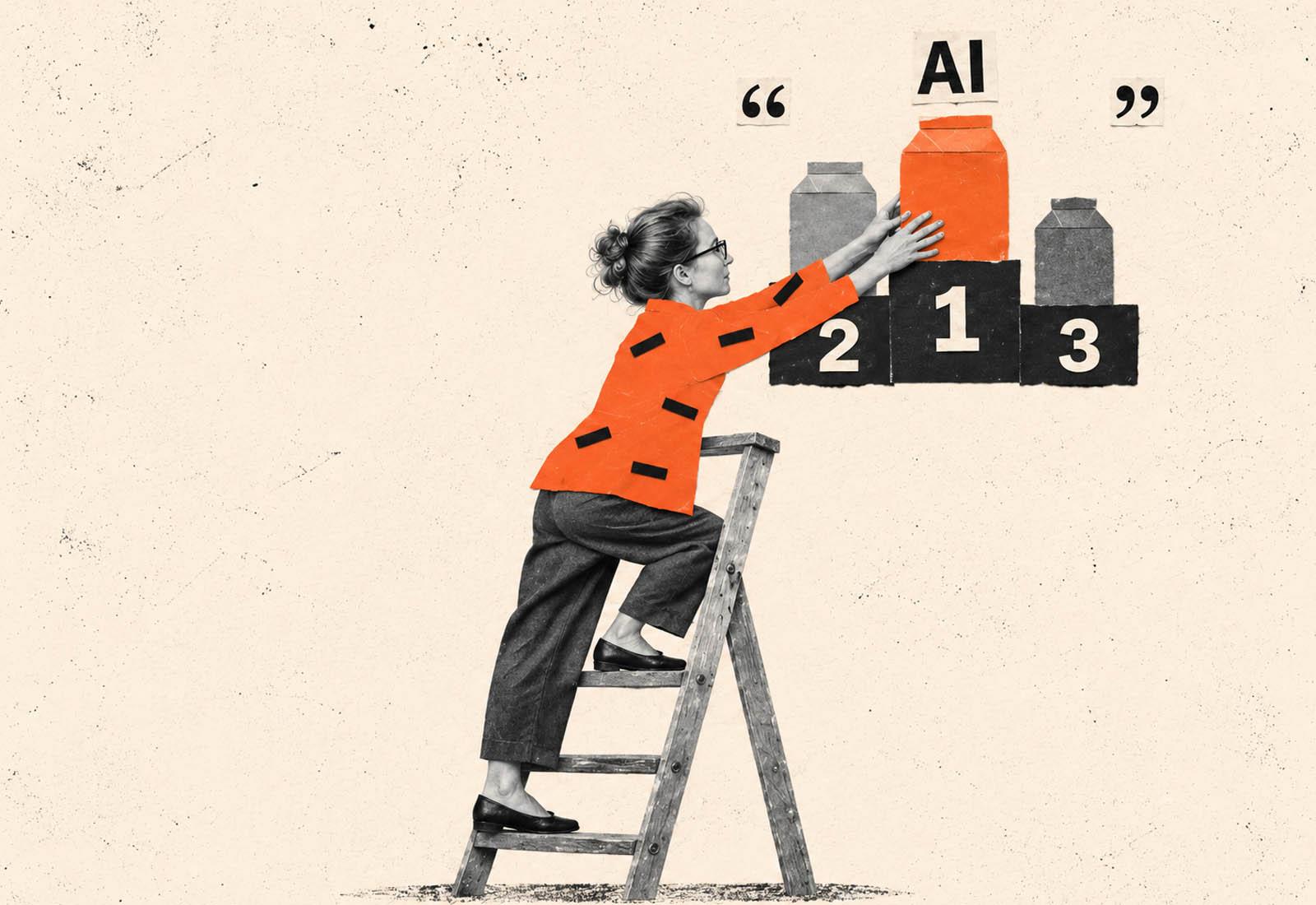
Between 2022 and 2027, more steps become possible, and each introduces another opportunity for distortion. The screenshot may show first place.
The real test is whether the recommendation still deserves the customer’s confidence.
From early chatbots to emerging shopping assistants, AI is changing how brands are discovered, compared and recommended