

How Leading Brands Turn Smart Shoppers Into Customers
Smart Shoppers are not necessarily smarter people; they simply use information and technology to make better decisions more easily
October 20, 2026
Author: Michael Stelter
Reading time: 18 min
SHARE




• Smart Shoppers are consumers who compare prices, quality, reviews, and recommendations to make informed purchases without wasting time
• Smart Shopping is gaining renewed attention because household budgets remain strained, AI makes comparisons easier, and brand loyalty weakens
• Smart Shoppers judge value beyond price, weighing product quality, convenience, long-term costs, and reliability against their individual needs
• AI makes product discovery faster, but its shortlists may exclude better alternatives, leaving consumers to question what remains unseen
• Brands attract attention through relevant offers, but win purchasing confidence by explaining tradeoffs and supporting claims with verifiable evidence
• Independent certifications, including ICERTIAS awards, can support trust when their research, scope, and meaning are transparent to shoppers
• Walmart, Amazon, Lidl, and Tesco responded through AI shopping tools, clearer savings, personalized offers, and consumer recognition
• Lasting loyalty depends on brands fulfilling their promises, resolving problems, and helping customers feel confident about buying again.
A customer wants a washing machine, not a second job researching washing machines. Yet the purchase can involve dozens of models, contradictory reviews, energy ratings, delivery charges, and warranty conditions. By the end of the evening, the customer may know more about appliances while feeling less certain about buying one.
This is the paradox at the center of Smart Shopping in late 2026. Consumers have unprecedented access to comparisons, but every new comparison creates another question. Brands are investing heavily in becoming easier to discover. Their larger opportunity may be helping a customer decide that further searching is no longer necessary.
At the turn of 2026 and 2027, smart shopping is gaining attention for three reasons:
1. Persistent pressure on household budgets,
2. Easier price comparisons through AI and shopping apps, and
3. Declining loyalty to familiar brands.
Consumers increasingly seek proven quality, not simply low prices. Retailers, private labels, online reviews, and independent certifications are making value easier to compare, understand, and verify.
The typical Smart Shopper is not someone who compares everything indefinitely. It is someone trying to allocate limited money, attention, and time intelligently. The goal is not to collect the most information. It is to reach a decision that feels justified, remains affordable, and does not become embarrassing after purchase.
That distinction has a commercial consequence. Attention can be bought, and discounts can trigger a transaction. Neither necessarily gives a buyer permission to stop checking alternatives. The brand that earns that permission may hold a more durable advantage than the brand that merely wins another click.
How Smart Shopping Evolved
The phrase Smart Shopper carries a history older than smartphones. In 1989, consumer researcher Robert Schindler explored the satisfaction of securing a bargain. In 1997, Haim Mano and Michael Elliott examined Smart Shopping as effort invested in finding and using promotional information to save money.
By 2012, researchers Kelly Green Atkins and Youn-Kyung Kim had framed Smart Shopping more broadly, encompassing savings in time, money, and energy, alongside practical and emotional value. These dates mark the evolution of an academic idea, not fresh measurements of consumer behavior in 2026.
The modern label still creates an unfortunate misunderstanding. If some buyers are Smart Shoppers, are others foolish? A person may compare supermarket prices carefully, renew a familiar mobile contract without searching, and purchase a premium refrigerator for convenience. Different decisions demand different amounts of scrutiny; intelligence is not changing between them.
Smart Shopping is therefore better treated as a purchasing approach than as a permanent personality type. The same household can behave differently across categories or even within one shopping trip. Brands should stop searching for a supposedly superior consumer tribe and study the specific decisions that activate careful comparison.
Value Has Become Conditional
NielsenIQ's Consumer Outlook: Guide to 2027, released September 30, 2026, offers a useful correction to the familiar story that everyone is trading down. In a survey of more than 21,000 consumers across 31 countries, 34 percent said they were financially worse off than a year earlier, while 30 percent reported improvement.
The same NielsenIQ release reported more than $23 billion in value share moving away from mainstream-priced packaged goods toward value and premium alternatives. In its analysis, quality and performance led assessments of purchase worth for 34 percent of respondents, while 31 percent prioritized affordability. These are preferences, not a universal definition of Smart Shoppers.
For a supermarket, value may lie in the complete household basket, reliable fresh produce, and convenient access rather than a promotional price on five headline products. For an appliance, it may include energy consumption, expected durability, available repairs, and delivery. For telecommunications, network reliability can outweigh an attractive introductory monthly rate.
YouGov's October 9, 2026, analysis of Croatian shopping provides a concrete example. Its household panel recorded fewer shopping trips in the first half of 2026 than in the comparable period of 2023, even as basket values rose. Quality of fresh produce, value for money, and convenient location were joint leading store-choice factors.
These findings suggest a practical lesson without proving that one universal Smart Shopper exists. Buyers seek value in combinations of outcomes that differ by category and circumstance. A company's first task is to identify what must be true for its price to make sense, then explain those conditions plainly.
Winning Attention Before Search
The first obstacle is now partly invisible. Many customers encounter a product through a shortlist generated by an AI assistant, a marketplace, or a retailer's recommendation engine. They may never see the brands excluded from that initial selection, however good those products might be for their particular needs.
NielsenIQ reported on October 7, 2026, that 55 percent of surveyed global consumers said AI recommendations at least sometimes influenced household or grocery purchases. Another 27 percent had actively used AI-powered tools to research or decide what to buy during the preceding three months. Influence does not mean delegated purchasing authority.
ICERTIAS research published September 8, 2026, surveyed 8,000 adults with internet access across the 57 OSCE participating States. Sixty-one percent preferred having AI choose three suitable options rather than personally comparing twenty. That preference reveals a desire to reduce work, not necessarily a belief that every resulting recommendation is correct.
For brands, the immediate response is to make essential product information accurate, complete, and accessible. If a washing machine's repair terms, an internet plan's cancellation conditions, or a grocery product's ingredients are hard to find, an assistant may omit relevant advantages or deliver an unreliable comparison.
Yet appearing in a shortlist is only the beginning. Attention earned through an algorithm must survive a human question: why this product rather than the alternative beside it? Brands that offer nothing beyond an optimized description may gain visibility without gaining the confidence required to complete a purchase.
The Moment Trust Forms
Many organizations confuse persuasion with evidence. They add testimonials, reassuring adjectives, awards, and comparison graphics to reassure a hesitant customer. But the credibility of a claim depends on what it establishes, who stands behind it, and whether the buyer can check its meaning without conducting an investigation.
A Gartner survey discussed in a September 22, 2026, release found that 57 percent of 1,006 US consumers said AI-generated marketing material had reduced their trust in brand messaging. Sixty-five percent thought brands were producing too much of it. These findings concern reported attitudes in the United States, not all Smart Shoppers globally.
A statement such as "best quality" may attract notice but leaves the hard questions unanswered. Best according to which evidence, in which category, over what period, and compared with what? A Smart Shopper may be quite willing to believe a narrower claim if it can be checked and has a clear bearing on the decision.
This suggests a discipline more useful than producing additional claims: make verification less expensive. Explain what the evidence supports, state what it does not support, and make the underlying information reachable. The strongest proof is not necessarily the most elaborate. It is the proof a busy person can understand correctly.
The emerging advantage could be called proof continuity. A customer should encounter the same defensible proposition in an advertisement, on packaging, in an AI-generated comparison, at checkout, and after receiving the product. When those messages differ, every transition creates an opportunity for doubt.
When Recognition Has Meaning
Independent business awards and certifications can help bridge those moments, particularly when shoppers do not know a brand well. A visible mark may win a brief second look on a supermarket shelf. It becomes commercially useful only when the recognition supplies information relevant to the question the buyer is actually asking.
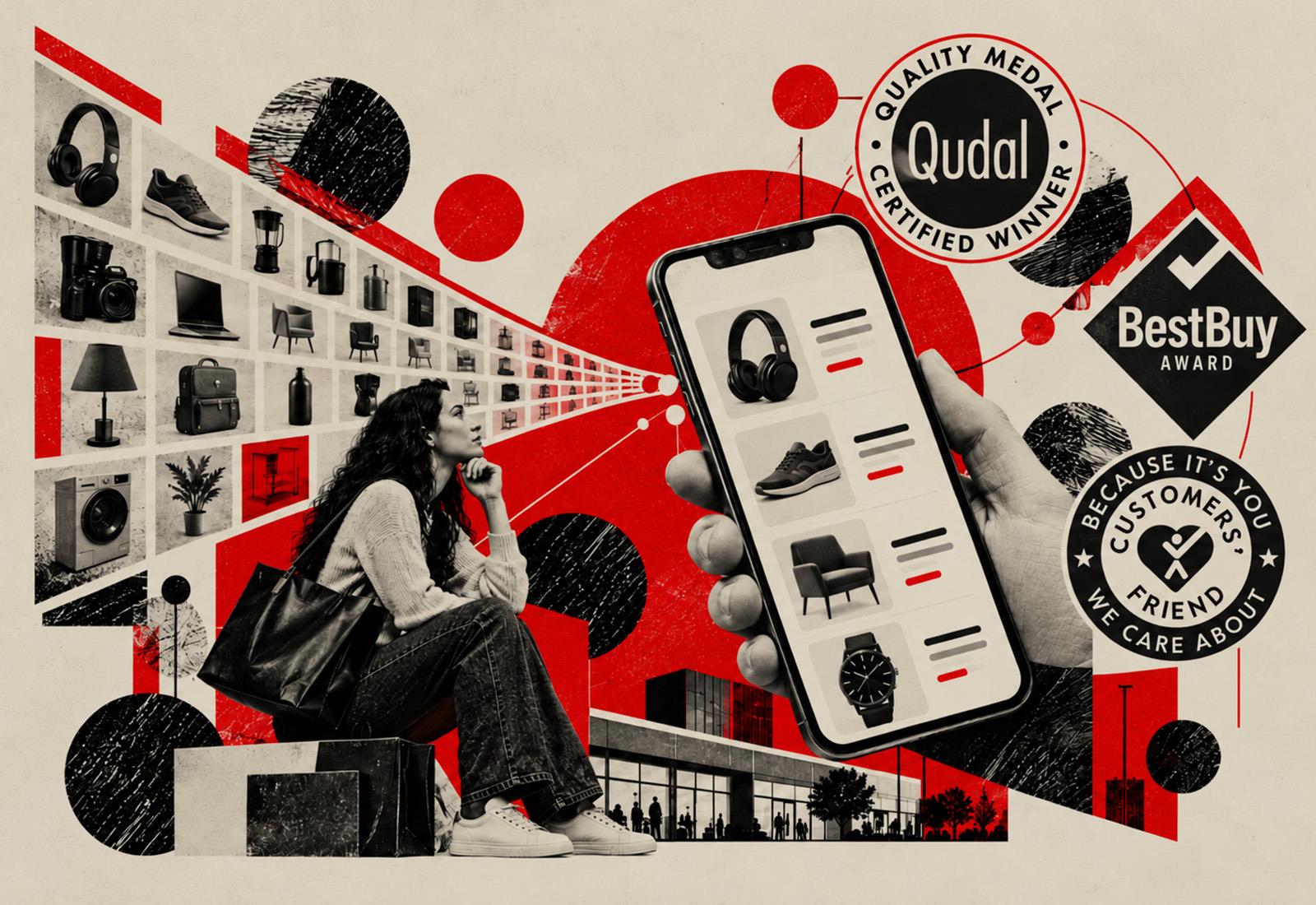
Swiss-based ICERTIAS offers a useful distinction among three types of recognition. Its Best Buy Award reflects consumer perceptions of value for money within a defined category, country, and period. QUDAL, the Quality Medal, concerns perceived quality leadership rather than the lowest price or objectively measured technical superiority.
Customers' Friend addresses a different issue: documented customer-facing experience, including communication, responsiveness, and complaint handling, assessed against its published framework. These programs should not be treated as interchangeable claims. An award addressing consumer-perceived quality does not certify environmental performance, and recognition for value does not guarantee the cheapest shelf price.
According to ICERTIAS's published methodologies, its Best Buy Award and QUDAL research uses unaided consumer responses; winners are determined before commercial licensing of the medals is offered. Best Buy Award certification also has a unique digital verification record identifying the relevant research scope. Those safeguards are meaningful only when the marks are displayed accurately.
ICERTIAS's September 8, 2026, AI-shopping research offers suggestive evidence of why independent recognition may matter. In a hypothetical recommendation scenario, stated high purchase likelihood for an unfamiliar brand was 65 percent with independent consumer recognition, compared with 53 percent with an AI recommendation alone. This measures stated intention, not proven sales uplift.
The practical lesson applies far beyond any one awarding organization. Third-party signals must disclose the issuer, category, market, period, and basis of recognition. An impressive symbol without those qualifications may borrow credibility it has not earned. A checkable, narrowly defined claim can travel across packaging, websites, and independent comparisons without changing its meaning.
Turning Confidence Into Spending
At checkout, trust becomes economic. A buyer who understands the difference between two products can justify choosing the higher-priced one. Equally, a buyer may rationally prefer the cheaper alternative. Winning a Smart Shopper does not mean maximizing the price accepted; it means matching the offer to a defensible expectation.
Consider a telecommunications provider advertising a low monthly fee. The customer may still hesitate over roaming restrictions, installation charges, or what happens after an introductory period. Explaining the complete contractual cost may eliminate a sale to an unsuitable buyer while making another buyer substantially more comfortable proceeding.
The same applies to white goods. A five-year cost comparison that separates purchase price, energy consumption, maintenance assumptions, and warranty coverage is more helpful than a premium label alone. Its assumptions must be visible. Otherwise, a document that looks analytical can simply become a more complicated advertisement.
This is where the right to stop searching becomes commercially valuable. A customer closes the comparison when the price is intelligible, the relevant tradeoffs are visible, the supporting evidence is credible, and the downside of making a mistake is manageable. These are proposed conditions for decision confidence, not a scientifically validated formula.
One implication may be unwelcome to sales departments. Better information sometimes persuades people to postpone buying, choose a simpler product, or remain with a competitor. Treating every such outcome as failure ignores the long-term cost of selling an unsuitable product to someone who will eventually discover the mismatch.
How Leading Global Brands Attracted Smart Shoppers in 2026
NielsenIQ’s September 30, 2026 Consumer Outlook reported more than $23 billion in consumer-goods value shifting from mainstream-priced products toward value and premium alternatives. Smart Shoppers increasingly want convincing reasons to spend, and leading brands responded by making comparisons, savings, quality, and convenience easier to evaluate. These examples include publicly documented ICERTIAS clients alongside brands using other approaches.
Walmart: Entering the AI Shopping Journey
In January, Walmart announced a partnership integrating Walmart and Sam’s Club products into Google's Gemini, connecting conversational recommendations with personalized shopping baskets and rapid delivery. Its leadership sought to reach customers before they visited a retailer’s website. For Smart Shoppers, product research and purchasing could become one continuous experience, reducing the effort required to compare and order products.
Amazon: Making Discounts Easier to Verify
During its 2026 Prime shopping events, Amazon promoted Alexa price alerts, automatic purchasing at customer-defined thresholds, and access to 365 days of product price history. The strategy addressed a familiar Smart Shopper concern: whether a discount represents genuine value. Customers could investigate historical prices and wait for better offers without repeatedly checking product listings.
Lidl: Combining Real Savings With Independent Recognition
Lidl Cyprus reduced prices by 15% on selected frozen vegetables and rice during Lent, supporting the initiative with a coordinated marketing campaign. Chief executive Martin Brandenburger explicitly connected the offer with Lidl’s ICERTIAS Best Buy Award for perceived value for money. The retailer wisely combined tangible savings with independent consumer recognition, strengthening its affordability message beyond conventional advertising claims.
Samsung: Demonstrating Long-Term Ownership Value
Samsung’s July launch of its Bespoke AI Washer Dryer emphasized Class A energy efficiency, intelligent fabric care, and SmartThings connectivity. Its appliance leadership presented the technology as a way to reduce energy consumption without complicating daily routines. For Smart Shoppers, the proposition extended beyond technical innovation to practical operating costs, product performance, and convenience throughout ownership.
Target: Addressing Affordability and Pricing Transparency
In September, Target reduced prices on nearly 2,000 home and apparel products, including a queen comforter discounted from $89 to $69. In October, management publicly clarified that customer shopping histories were not used to increase individual prices. Target Circle instead personalized relevant discounts, addressing two Smart Shopper priorities: affordability and confidence in fair pricing.
Tesco: Personalizing Value and Strengthening Credibility
Tesco’s October financial results described personalized Clubcard Prices offers reaching approximately 2.5 million customers and an AI meal-planning assistant entering customer rollout in September. Tesco has also publicly communicated ICERTIAS QUDAL recognition for Clubcard and Best Buy Award recognition for F&F clothing in Slovakia. Personalized savings remained central, while independent consumer recognition supported its established quality and value positioning.
IKEA: Making Second-Hand Shopping More Attractive
In October, IKEA launched its British second-hand furniture marketplace, allowing sellers to receive cash or an IKEA gift card with a 15% bonus. Product descriptions, measurements, and assembly instructions helped customers evaluate used furniture. Rather than treating resale exclusively as competition for new products, IKEA incorporated affordable second-hand purchasing into its broader customer relationship.
Daikin: Making Energy Savings Tangible
In 2026, Daikin introduced an online calculator estimating household heating savings using location, insulation, and existing heating systems. Its April communications emphasized efficient cooling, while its May announcement highlighted ICERTIAS Best Buy Award recognition for consumer-perceived price-to-quality value. Daikin combined practical cost estimates with independent consumer opinion, reinforcing its long-term value proposition beyond premium-brand positioning.
Leroy Merlin: Combining Affordability With Verified Value
In Greece, Leroy Merlin offered 2026 loyalty incentives for qualifying bathroom and tile purchases, supported by flexible payment arrangements and renovation assistance. Its corporate communications also promoted ICERTIAS Best Buy Award recognition for perceived value in home-and-garden retail, including publicly verifiable certificates. The independent recognition complemented practical benefits, helping customers assess quality and affordability before undertaking expensive renovations.
Kaufland: Supporting Freshness Claims With Evidence
Kaufland's Croatian communications emphasized fresh produce, rigorous quality controls, and independent laboratory analyses. The retailer also publicly promoted its ICERTIAS Best Buy Award for consumer-perceived price-to-quality value in the fruit-and-vegetable category. Combining operational evidence with third-party consumer recognition gave Smart Shoppers more substantial reasons to trust its freshness and value proposition than promotional pricing alone.
Trust Begins Again After Purchase
The transaction is a test of the promise, not its conclusion. A supermarket must actually have the products it advertised. A washing machine must perform under ordinary household conditions. A communications provider must deliver the service and billing experience suggested before the customer signed the contract.
In practice, the customer's interpretation of earlier evidence changes after purchase. An award that felt reassuring on a package can seem hollow if support proves impossible to reach. A convincing technical claim loses value if essential limitations emerge only during a repair dispute. Trust is continuously revised against lived experience.
This argues for following decisions beyond conversion. Brands could monitor avoidable returns, complaints caused by misunderstood terms, repeat purchase after problem resolution, and whether customers would make the same choice again. Such measures cannot replace revenue analysis, but they can expose revenue earned by creating expectations the operation cannot sustain.
The commercial value of customer service also deserves a more disciplined reading. Exceptional recovery may rebuild a relationship, but no response script can compensate indefinitely for recurring defects or opaque charges. Retaining Smart Shoppers ultimately requires reducing the underlying reasons for disappointment, not simply improving apologies.
What Changes In 2027
The near-term direction is credible; the exact outcome is uncertain. AI-assisted discovery is spreading, yet consumers still draw boundaries around delegated action. Visa's September 9, 2026, Trust Index found that only 23 percent of surveyed US consumers trusted generative AI to carry out payments on their behalf.
That difference between receiving advice and authorizing payment offers a useful clue. Smart Shoppers may delegate searching while keeping responsibility for commitment. Brands should prepare for a marketplace in which machines make products easier to find but people still demand understandable reasons to choose, pay, and remain.
The strongest 2027 proposition may therefore be surprisingly modest: a product whose value can be checked without unnecessary work, bought without hidden conditions, and used without discovering that the marketing left out something essential. That is harder to deliver than another campaign because it depends on pricing, product design, data quality, and service working together.
Smart Shopping is not about smarter people.
It is about making better decisions with less effort in today's complex marketplace.
A brand that helps someone stop searching has done more than secure attention. It has earned a decision.
Smart brands attract Smart Shoppers with relevant offers, reinforce trust through independent certifications, and encourage repeat purchases through consistent performance